 info@svetzbrani.cz
 +420 775 760 500
.png)
If you own an air rifle and are looking for the right riflescope, you have come to the right place. The right optics for an air rifle is a key element of accurate shooting and improving your overall shooting experience. In this guide, we provide useful tips and information to help you choose the right scope for maximum shooting performance.
TIP: Don't want to choose optics separately? Check out our air rifles with scope - complete sets ready to shoot.
Always follow local firearms regulations and safety rules.
What scope do I need?
| Purpose | Recommended Magnification | Important Features |
|---|---|---|
| Shooting up to 25m (backyard) | 3-9x | Basic quality, affordable price |
| Target shooting 25-50m | 4-12x | Parallax adjustment, Mil-Dot reticle |
| Precision shooting 50m+ | 6-24x | Large objective (50mm), SF, high-quality optics |
| Pest control / hunting | 3-12x | Illuminated reticle, durability, fast focus |
Consider your needs. Before you start choosing a scope, ask yourself a few questions:
- What activity do you plan to do with your air rifle? (hunting, target shooting, competitive shooting, etc.)
- At what distance do you want to shoot?
- What level of precision and magnification do you require?
Magnification and Objective Lens
The magnification of a scope determines how much you can zoom in on the target. For short-range shooting or hunting in tight spaces, low to medium magnification (1-4x) is suitable. For longer-range shooting, choose higher magnification (4x and above). The size of the objective lens affects the brightness of the scope. A larger objective lens gathers more light and is ideal for shooting in poor lighting conditions.
Optical Quality
Optical quality is essential for a sharp and bright image. Look for scopes with high optical quality, minimal distortion, and anti-reflective lens coatings. This ensures an accurate image and excellent visibility in various lighting conditions. From our range, we recommend riflescopes from the Valiant brand.
Reticle (Crosshair)
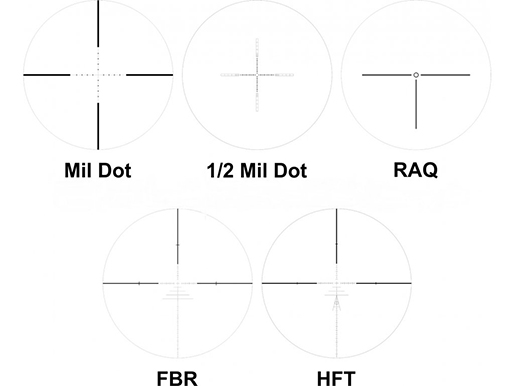
The Mil-Dot reticle is designed with small dots and lines that allow you to estimate distance and compensate for ballistic factors. It is an excellent choice for sport shooting and longer-range hunting situations. However, be cautious with cheap scopes, as they may not have a standardised Mil-Dot reticle, which can affect its precision and effectiveness.
Another option is scopes with illuminated reticles. They are very popular due to their ability to provide a clear image in poor lighting conditions. While they will not help with shooting in complete darkness, they are an excellent solution in low-light situations or when shooting against the light, where a normal reticle might be difficult to see. For shooting in total darkness, there are specialised night vision scopes.
Types of Reticles
- Duplex - a classic crosshair with thick lines on the edges and thin lines in the centre, the most widely used type
- Mil-Dot - a reticle with dots for estimating distance and compensating for bullet drop
- BDC (Bullet Drop Compensator) - markers for compensating bullet drop at various distances
- Illuminated - with illumination for shooting at dusk or dawn
Choosing the right reticle is therefore an important decision when selecting a scope. The Mil-Dot reticle is popular for its versatility and ability to compensate for various factors. Illuminated reticles are appreciated in poor lighting conditions. When choosing, however, pay attention to the quality and standardisation of the reticle to get the best performance and precision from your scope.
Durability and Shock Resistance - Why "Airgun Rated"?
Air rifles can generate shocks and vibrations that affect the precision and reliability of a scope. Spring-piston air rifles generate so-called "double recoil" - first forward when the piston is released, and then backward when the piston hits the end of the cylinder. Regular firearm scopes cannot withstand this specific type of stress.
Why you need an "airgun rated" scope (more about the differences at Pyramyd Air):
- Specially reinforced construction for bi-directional shocks
- More durable mounting of optical elements
- Better sealing against dust and moisture
- Guaranteed precision even after thousands of shots
IMPORTANT: A regular firearm scope on an air rifle will quickly be destroyed. Always choose optics labelled as "airgun rated", "shockproof", or "for air rifles".
CRITICAL for spring-piston air rifles: Spring-piston air rifles require STRONGER scopes than PCP air rifles! The double recoil and vibrations are more intense than those of firearms. A one-piece mount is MANDATORY for spring-piston air rifles - two-piece mounts can come loose. Cheap scopes (under €60) often do not last more than 100-500 shots on a spring-piston air rifle!
Adjustment Options
It is important to consider the adjustment options of a scope. Make sure the scope has sufficient elevation and windage adjustment capabilities for proper zeroing.
Parallax - What Is It and Why Does It Matter
Parallax is an optical error where the reticle shifts relative to the target when you move your eye. With air rifles, parallax is critical because you shoot at shorter distances (10-50m) than with firearms. A detailed selection guide can be found at Hard Air Magazine.
- Fixed parallax - set by the manufacturer at a specific distance (usually 50-100m), not suitable for air rifles
- Adjustable parallax (AO/SF) - can be adjusted to a specific shooting distance (from 10m), recommended for air rifles
AO (Adjustable Objective) - adjustment on the objective lens. SF (Side Focus) - side adjustment, more convenient while aiming.
Eye Relief
Eye relief is the distance from your eye to the eyepiece at which you can see the full image. For air rifles, sufficient eye relief (min. 7-10 cm) is important for comfortable aiming without having to hold your eye too close to the eyepiece.
Windage and Elevation Adjustment
A high-quality scope has precise "clicks" for windage and elevation adjustment. Look for scopes with:
- Clearly tactile clicks when turning
- Marked correction values (MOA or MRAD)
- Sufficient correction range for zeroing
How to Zero a Scope on an Air Rifle
After mounting the scope, it is necessary to carry out zeroing (sight adjustment) so that the reticle corresponds to the actual point of impact. Proper scope zeroing is the foundation of accurate shooting.
Step-by-Step Zeroing Procedure
- Prepare a stable rest - use shooting bags or sandbags
- Start at a short distance - ideally 10 metres for the initial adjustment
- Fire 3 shots at the target - aim precisely at the centre
- Analyse the grouping - determine where the pellets hit relative to the centre
- Make corrections - use the clicks to adjust elevation and windage
- Repeat - fire another 3 shots and verify the setting
- Increase the distance - after zeroing at 10m, try 25m and adjust if necessary
TIP: When zeroing your scope, always fire a minimum of 3 shots before making adjustments. A single shot can be affected by shooter error.
Scope Mounts - 11mm vs 22mm (Weaver/Picatinny)
Before mounting a scope, check the rail type on your air rifle. There are two basic types:
- 11mm rail (dovetail) - the most common on air rifles, narrower profile, typical for European air rifles
- 22mm rail (Weaver/Picatinny) - wider, more robust, more common on American air rifles and firearms
When choosing scope mounts, make sure they fit both the rail type on your rifle and the scope tube diameter (usually 25.4mm or 30mm).
CRITICAL for spring-piston air rifles: Use a one-piece mount! Two-piece mounts can come loose due to double recoil. For PCP air rifles, two-piece mounts are acceptable.
Budget
The last factor to consider is your budget. Scopes vary in price range and quality. Consider how often and intensively you plan to use the scope. For professional competitions or hunting expeditions, it may be wise to invest in a higher-quality scope from Valiant. For regular shooting activities, there is also a wide range of affordable scopes, for example from the Umarex or Walther brands, which provide good quality at a reasonable price.
Popular brands:
- Delta Optical - European brand known for quality optics at competitive prices. The Delta Optical Classic 3-9x40 is one of the most popular scopes for spring-piston air rifles (€60-€100)
- Hawke Optics - British brand with an extensive range of airgun-specific scopes (€100-€400)
- Bushnell - American classic, trusted by shooters worldwide (€80-€300)
- Vortex Optics - renowned for their unconditional lifetime warranty and great value (€160-€600)
Price ranges:
- Beginner: up to €60 (Walther, Vogler) - suitable for recreational shooting up to 25m
- Mid-range: €60-€100 (Delta Optical Classic, Bushnell) - the most popular choice for spring-piston and PCP air rifles
- Upper mid-range: €100-€200 - for precision shooting at longer distances
- Premium: €200-€400 (Delta Optical Titanium, Hawke) - for competitions and professional use
- High-end: €400+ (Leupold, top Hawke) - for demanding shooters and competitors
Frequently Asked Questions
What magnification do I need for an air rifle scope?
For shooting up to 25 metres, 3-9x magnification is sufficient. For target shooting at 25-50 metres, we recommend 4-12x, and for precision shooting at 50+ metres, 6-24x.
Does an air rifle scope need to be shockproof?
Yes, especially for spring-piston air rifles. Air rifles generate specific shocks and vibrations that regular firearm scopes cannot withstand. Choose scopes labelled as "airgun rated" or "shockproof". For spring-piston air rifles, use a one-piece mount!
What does the designation 3-9x40 mean?
The first numbers (3-9x) indicate the magnification range - the scope can be set from 3x to 9x zoom. The number 40 indicates the objective lens diameter in millimetres - a larger objective = more light.
Which reticle to choose - Mil-Dot or classic?
The Mil-Dot reticle is suitable for advanced shooters who want to estimate distances and compensate for ballistics. For beginners and recreational shooting, a classic crosshair or simple aiming points are sufficient.
Is an illuminated reticle worth buying?
You will appreciate an illuminated reticle when shooting in poor lighting conditions or against the light. For shooting in daylight, it is not necessary, but it can be a nice bonus.
What is parallax and why is it important for air rifles?
Parallax is an optical error where the reticle shifts relative to the target when you move your eye. It is critical for air rifles because you shoot at shorter distances (10-50m). Choose scopes with adjustable parallax (AO or SF) from 10m.
What eye relief is sufficient?
Eye relief (the distance from your eye to the eyepiece) should be at least 7-10 cm for comfortable aiming. Shorter eye relief can be uncomfortable, especially with higher magnification scopes.
What mount for a scope - 11mm or 22mm?
It depends on the rail type of your air rifle. Most European air rifles have an 11mm rail (dovetail), while American air rifles often have a 22mm rail (Weaver/Picatinny). Check your rifle's specifications and buy the appropriate mount. For spring-piston air rifles: a one-piece mount is mandatory!
How to zero a scope on an air rifle?
After mounting, start zeroing at 10 metres. Fire 3 shots, analyse the grouping, and use the correction clicks to adjust elevation and windage. Repeat until the hits correspond to the aiming point. Then increase the distance to 25m and adjust accordingly.
Next Steps
Have you chosen your scope? These articles will help you with further equipment:
- How to Choose an Air Rifle? - A complete guide to choosing an air rifle
- What Ammo for an Air Rifle? - A guide to choosing diabolo pellets
- How to Improve Shooting Accuracy? - 7 practical tips for better hits
- Air Rifle Accessories - A complete accessories guide (PCP pumps, scopes, silencers, targets)
Conclusion
Choosing the right riflescope is crucial for achieving maximum precision and performance from your air rifle. Consider your needs, magnification, objective lens size, optical quality, durability, adjustment options, and budget. With the right scope, you will gain control over your air rifle and enjoy precise shooting. From our range, we recommend for recreational shooting and beginners scopes from Walther. For quality optics at a competitive price, Delta Optical scopes are an excellent European brand with a strong reputation among airgun enthusiasts. For professional shooting and dedicated enthusiasts, we carry Valiant scopes, which are built to withstand energy of approximately 7,000 J!
This article is based on information from the ISSF, Pyramyd Air tests, and Hard Air Magazine. Updated January 2026.